Vacuum Suction Cup Selection: Size, Material and Surface
A vacuum suction cup needs to establish a suitable seal on the workpiece and work with the rest of the vacuum circuit. Start with the contact surface and handling task before choosing a diameter or material.
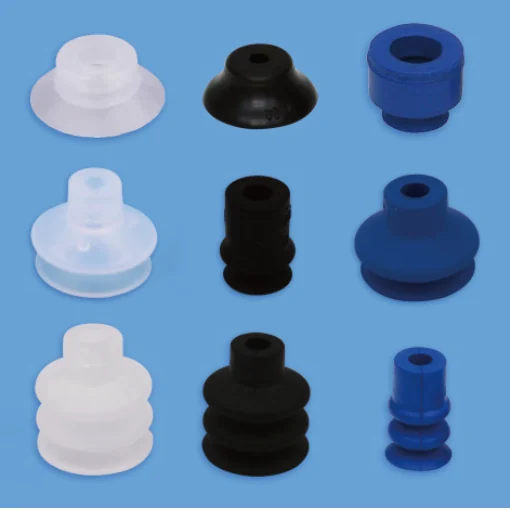
1. Map the available contact surfaces
Mark areas that allow contact and identify ribs, seams, openings, curvature or texture near the proposed sealing lip. Note restrictions on cosmetic marks, deformation or contact with finished surfaces.
Provide examples from actual production. If the surface varies with mold finish, process conditions or part geometry, describe that variation in the inquiry instead of supplying only an ideal drawing.
2. Match shape and material to the task
Compare cup geometry with the usable contact area and the way the tool approaches the part. Schmalz’s selection guidance treats workpiece properties, cup material and size as linked selection inputs.
Specify temperature at pickup, exposure to oil or cleaning products, required wear characteristics and any downstream finishing process. Ask for the exact material grade and its documented limits. A general material name alone does not confirm compatibility.
If food-contact, electrical or other special properties are required, request documentation for the exact supplied component. Do not infer a certification from the material family or appearance.
3. Interpret holding-force figures correctly
Check the stated vacuum level, reference surface and loading direction behind a quoted force. Schmalz distinguishes theoretical suction force perpendicular to the surface from other application loads.
For your assembly, document the part weight, acceleration, orientation, number of cups and load distribution. Ask the supplier or integrator to assess the chosen configuration and appropriate design margin.
Avoid dividing a headline force by gravity and treating the result as a guaranteed payload. The actual application needs to account for contact conditions and the complete movement.
4. Review the vacuum circuit and release
Describe the vacuum source, tubing layout, connections, required pickup time and monitoring. Check the achieved vacuum at the tooling during the cycle, rather than relying solely on a source specification.
For multiple cups, discuss what the system should do if a cup cannot seal or a workpiece is missing. The circuit and control response should be designed for the intended operation.
Plan the release position and method. Include release in the trial sequence, particularly when the next operation requires consistent placement.
5. Run a representative selection trial
Prepare a trial record covering part type, cup code, surface condition, temperature, vacuum conditions and movement. Define acceptable retention, release, surface appearance and positioning before testing.
Use representative parts and the intended sequence. A successful stationary pickup is only one part of checking a moving production application. Document observations so that material or size changes can be compared consistently.
6. What to send for a suction cup quotation
Send the part drawing, contact-area photos, weight, orientation, temperature, surface restrictions, cycle requirements and available vacuum equipment. State the quantity and mounting connection needed.
Browse the vacuum cup category and confirm the exact cup and fitting combination. Keep the approved material, size and connection codes together for replacement ordering.
Frequently asked questions
Is a larger suction cup always better?
No. The usable contact area, surface shape, clearance, vacuum circuit and handling task all affect the selection.
Can I choose a cup from its listed suction force alone?
No. Review the reference conditions and assess the application’s loading direction, motion, contact and load distribution.
Should I test the cup on an actual molded part?
Yes. Representative trials help assess sealing, retention, release and surface appearance under the intended conditions.
Technical references
These references explain general selection principles; they do not establish identical specifications or interchangeability with the products listed here.