Manual vs Automatic Robot Tool Changers: How to Choose
A robot tool changer connects the robot to interchangeable tooling. The decision between manual and automatic changing begins with the production process: who changes the tool, when it happens and whether the cell must perform the exchange without an operator.
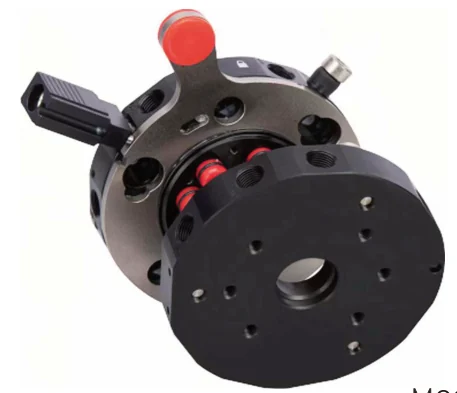
1. Start with the changeover workflow
List the tools used in each shift and when they change. Separate scheduled changes between batches from exchanges performed inside an automatic cycle. Record the current downtime and identify whether disconnecting utilities, positioning tooling or checking the setup takes the most time.
A manual arrangement can suit planned changes made by an operator. An automatic arrangement becomes relevant when the robot must exchange tooling as part of its programmed sequence. Neither description, by itself, proves suitability for a specific installation.
2. Compare the complete installation
For a manual system, review operator access, the handling weight of each disconnected tool, locking confirmation and how air or electrical connections are made. Include a suitable storage location in the layout.
For automatic changing, map the docking position, approach path, tool stand, alignment requirements and control signals. Confirm which items are included with the changer and which need separate specification. An automatic changer alone does not constitute a complete automatic tool-exchange station.
3. Check load and interfaces independently
The same robot may carry several tools with different weights and centers of gravity. Check every proposed assembly against the selected changer’s load and moment limits. ATI’s selection guidance specifically highlights moment capacity as a key selection factor.
Document the robot flange, adapter plates, tool-side mounting and clearance. A matching nominal diameter does not confirm that the bolt pattern, fasteners or utility interfaces will fit.
4. Specify utilities and confirmation signals
List the pneumatic circuits, vacuum connections and electrical signals that must cross the interface. Define each circuit’s purpose and operating requirements rather than specifying only the number of ports.
Discuss how the controller will confirm the required states before movement. For automatic exchanges, ask the integrator to document docking, locking, tool identification where required, and recovery from an interrupted exchange. Follow the selected equipment’s operating instructions.
5. Compare costs using your own process data
Request quotations for the complete arrangements, including adapters, tool-side units, storage or docking equipment, sensors, commissioning and spare parts. Comparing only the changer body price misses parts of the project.
Estimate the value of changeover time using measured changes per shift and actual production costs. Do not assume an automatic system will pay for itself within a fixed period without those inputs.
6. Where to begin in the Robotics Gripper catalog
The catalog separates manual MQC and automatic AQC options. Use the category page to identify candidate families, then request confirmation of the exact mounting, utility and load configuration.
Send the robot model, drawings of each tool, total attached weight, center-of-gravity information, changeover frequency and required circuits with your inquiry.
Frequently asked questions
Does automatic tool changing always save money?
It depends on change frequency, downtime, staffing and integration cost. Compare complete systems using measured production data.
Can manual and automatic changers use the same tool-side plate?
Do not assume interchangeability. Confirm the exact mating interfaces and ordering codes with the supplier.
Is rated payload enough to choose a changer?
No. Check moments, tool geometry, operating conditions and mounting and utility interfaces as well.
Technical references
These references explain general selection principles; they do not establish identical specifications or interchangeability with the products listed here.